AI-Powered Document Intelligence for Research Operations
Combining deep AI system experimentation with production healthcare research to build automated classification, metadata extraction, and a queryable research repository, preserving researcher attention for interpretation, judgment, and synthesis.

The Challenge
UX research operates at human speed in a machine-scale world. The volume of documents, transcripts, and artifacts generated exceeds any individual researcher’s ability to maintain coherent context.
The core question that shaped everything: How do you apply AI to research operations in ways that amplify human judgment?
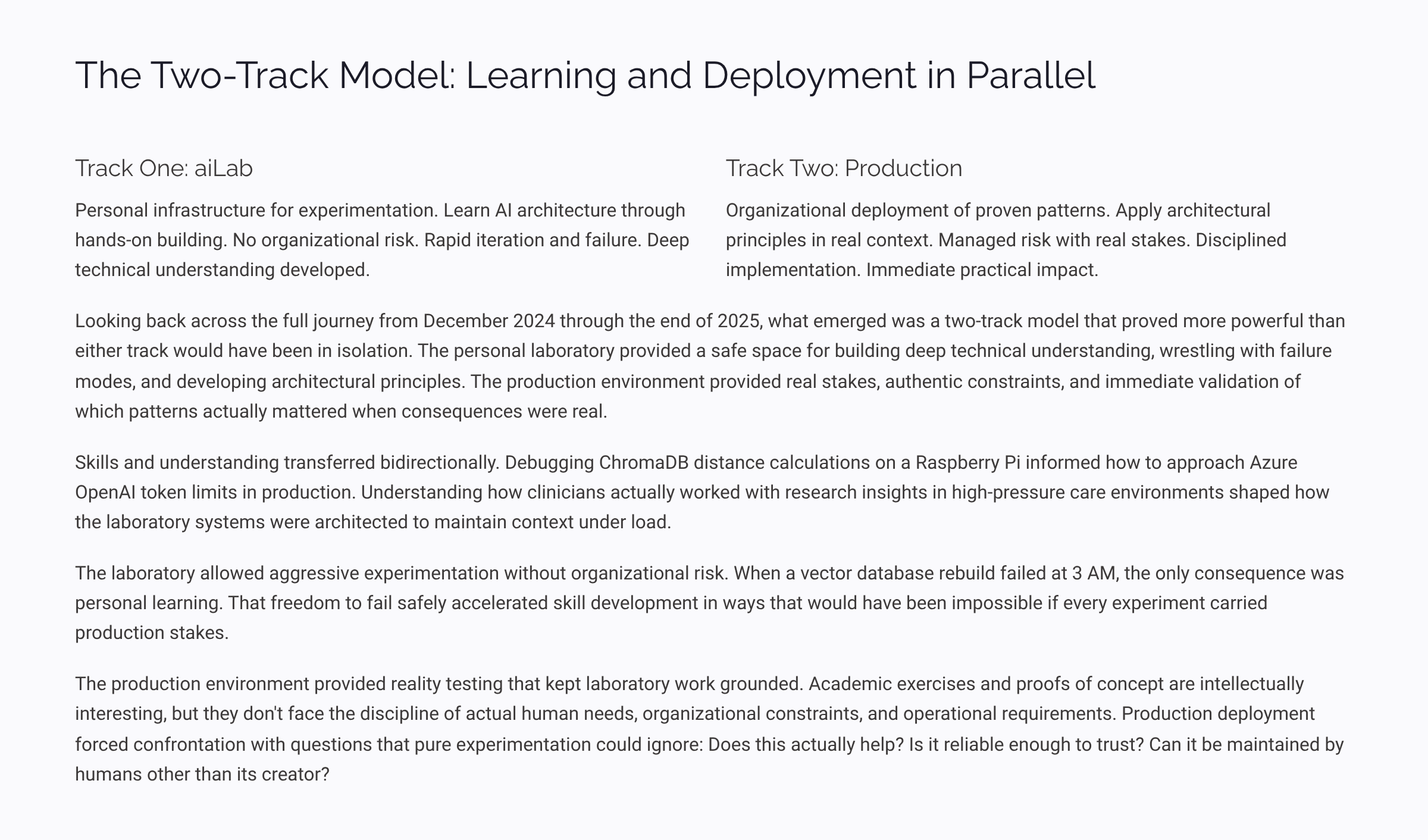
Approach: The Two-Track Model
A parallel track model emerged: personal laboratory experimentation alongside production deployment at Montefiore.
Track One: AILab (Personal)
Infrastructure for experimentation. Learning AI architecture through hands-on building on a Raspberry Pi 5 with ChromaDB, sentence-transformers, and BGE embeddings. No organizational risk. Rapid iteration and failure. Deep technical understanding developed through building a complete RAG pipeline from scratch.
Track Two: Production
Organizational deployment of proven patterns using Microsoft Power Automate and Azure OpenAI GPT 4o. Applying architectural principles in a real healthcare context with real constraints. Document classification, metadata extraction, and indexing into a queryable SharePoint repository.
Skills and understanding transferred bidirectionally. Debugging ChromaDB distance calculations on the Pi informed how to approach Azure OpenAI token limits in production. Understanding how clinicians actually worked with research insights shaped how the laboratory systems were architected.

Core Architecture Principles
Source documents remain immutable. Derived intelligence is explicitly disposable. Separate what must never change from what can always be rebuilt.
This separation proved transformative. AI systems could be aggressive in processing, experimental in approaches, continuously improving, because mistakes never compromised the underlying truth. When better models became available, the entire intelligence layer could be regenerated.
System Capabilities Built
- Classification: Automatic document type identification with 95%+ accuracy across research artifacts, design documents, transcripts, and administrative files. AI assigned category, program, artifact type, summary, tags, and confidence level.
- Metadata Extraction: Structured data capture from unstructured sources with tiered extraction handling across 9 file types. Processing time was 8 to 12 seconds per file.
- Indexing: Searchable SharePoint Document Index with quality review workflow.
- Folder Taxonomy Suggester: A second flow that queried the Document Index, extracted document names and tags, and sent the collection to GPT 4o for pattern analysis. The AI returned a hierarchical folder structure recommendation based on accumulated content.
- Telemetry Layer: Tracking top queries, zero-result queries, and most-cited sources, producing a weekly digest that made organizational learning patterns visible.

The Bridging Principle
Automate the Mechanical. Protect the Human.
Mechanical work is predictable, repetitive, and structurally consistent. It includes organizing information systematically, applying labels consistently, normalizing data formats, cross-referencing related materials. These tasks matter, but they do not require judgment or ethical reasoning.
Human work involves navigating ambiguity without forcing premature closure. It requires ethical reasoning about how insights might be used or misused. It demands contextual interpretation that accounts for what is not being said, for organizational politics, for historical context that is not documented anywhere.
AI cannot replace human work. It can support humans by handling mechanical burden that would otherwise consume their capacity for judgment.

Impact
Automation did not accelerate research by making individual studies faster. The time required to conduct a quality interview, observe a workflow, or facilitate a usability session remained unchanged.
Automation accelerated research by making it steadier and more consistent. Researchers spent less time reconstructing context from memory or searching through old folders. They started new work with better awareness of what was already known. The cognitive burden of maintaining institutional memory moved from individual human minds to a system that could hold it without fatigue.
Key Outcomes
- Researchers could point to a centralized location for all research artifacts. Filing new research was as simple as placing the report in a designated folder, then the automation handled classification and indexing.
- The Folder Taxonomy Suggester demonstrated the system could analyze its own contents and recommend structural improvements.
- The telemetry layer transformed a passive document store into an active signal of organizational learning needs.
- Documentation ensured the architecture could be handed off and continued by others.
Reflection
What Worked Well
- Two-track model: Personal lab provided freedom to fail; production provided reality testing. Neither alone would have been sufficient.
- Immutability principle: Separating source truth from derived intelligence enabled aggressive experimentation without risk.
- Starting with classification: Document organization was mundane but foundational. It enabled everything else.
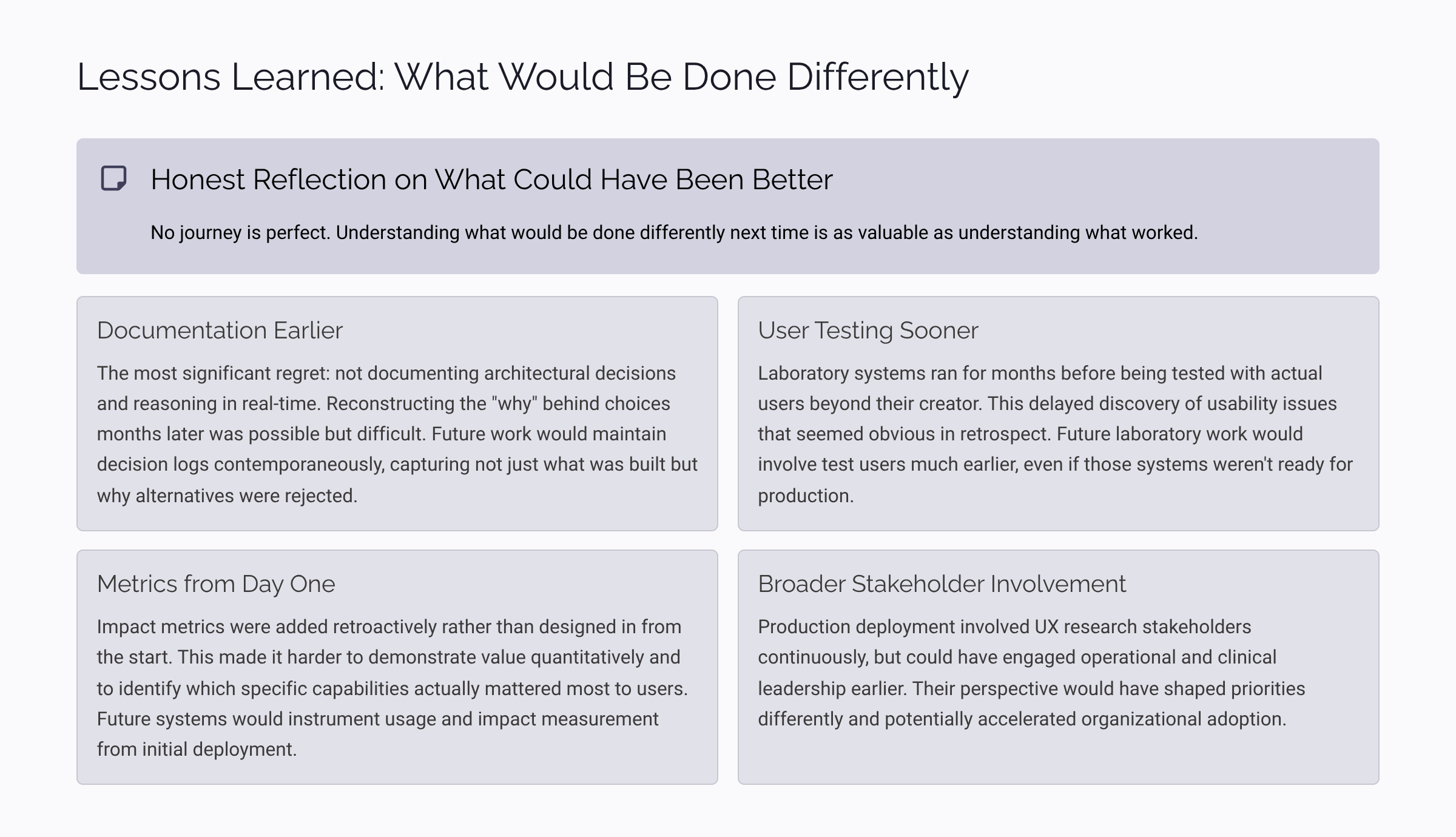
What I Would Do Differently
- Start production deployment earlier: Lab work was valuable but some lessons only emerged under real constraints.
- Build retrieval before generation: The urge to generate summaries was strong, but retrieval infrastructure proved more valuable.
- Document architecture decisions as they happen: Reconstructing rationale later was harder than capturing it in the moment.
Principles for Others
- Separate what must never change from what can always be rebuilt
- Automate the mechanical to protect capacity for the human
- Start with organization. It is boring but foundational.
- Build retrieval infrastructure before generation capabilities
- Maintain human override at every decision point